 Add to Chrome
 Add to Firefox
 Add to Edge
Explainable AI for Data-Driven Design of High-Dimensional Predictive Studies
May 21, 2026
Predictive modelling is important for health data analysis and data-driven clinical decision-making. However, predictive studies are challenging to design optimally by hand when tens or even hundreds of features require selection, transformation, or interaction modelling. While complex machine learning models offer high performance, their "black-box" nature limits the clinical trust, transparency, and interpretability required for decision-making. We developed and evaluated an Exploratory AI Recommender that provides data-driven recommendations to improve predictive performance of existing interpretable statistical models. The developed framework uses flexible AI modelling to capture complex data patterns and explainable AI techniques to translate the patterns into three recommendation types: feature exclusion, non-linear terms, and feature interactions. We evaluated the framework by comparing predictive performance of a baseline (i.e., no interactions or non-linear terms) Cox Proportional Hazards (CPH) model against an augmented CPH incorporating recommendations suggested by our method. The primary analysis predicts the time to the first occurrence of a fall or related injury in 245,614 patients. Our method recommended excluding 23 features, including non-linear terms for two features, and including 221 suggested feature interactions. The C-index improved from 0.805 (95% CI 0.798-0.812) to 0.815 (95% CI 0.809-0.822), and so did calibration (intercept: -0.006 to 0.003; slope: 1.063 to 0.950). All recommendations were supported by existing literature. The method also proved effective on two additional public datasets, demonstrating wider applicability. The proposed Exploratory AI Recommender demonstrates the potential of explainable AI and data-driven study design to improve the process of developing, and the performance of high-dimensional transparent predictive models.

Adverse Event Extraction from Discharge Summaries: A New Dataset, Annotation Scheme, and Initial Findings
Jun 17, 2025In this work, we present a manually annotated corpus for Adverse Event (AE) extraction from discharge summaries of elderly patients, a population often underrepresented in clinical NLP resources. The dataset includes 14 clinically significant AEs-such as falls, delirium, and intracranial haemorrhage, along with contextual attributes like negation, diagnosis type, and in-hospital occurrence. Uniquely, the annotation schema supports both discontinuous and overlapping entities, addressing challenges rarely tackled in prior work. We evaluate multiple models using FlairNLP across three annotation granularities: fine-grained, coarse-grained, and coarse-grained with negation. While transformer-based models (e.g., BERT-cased) achieve strong performance on document-level coarse-grained extraction (F1 = 0.943), performance drops notably for fine-grained entity-level tasks (e.g., F1 = 0.675), particularly for rare events and complex attributes. These results demonstrate that despite high-level scores, significant challenges remain in detecting underrepresented AEs and capturing nuanced clinical language. Developed within a Trusted Research Environment (TRE), the dataset is available upon request via DataLoch and serves as a robust benchmark for evaluating AE extraction methods and supporting future cross-dataset generalisation.
Infusing clinical knowledge into tokenisers for language models
Jun 20, 2024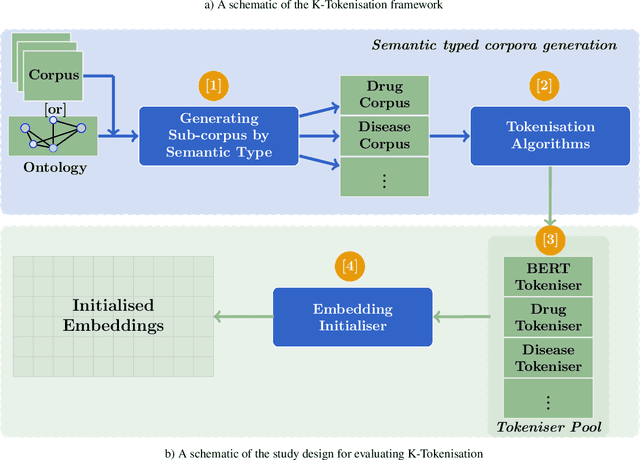
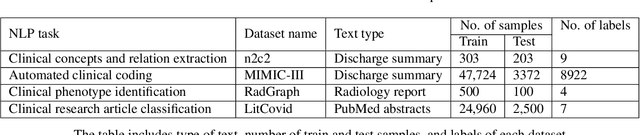
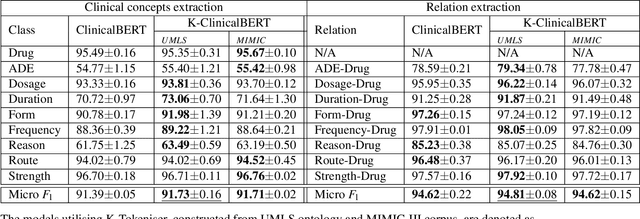
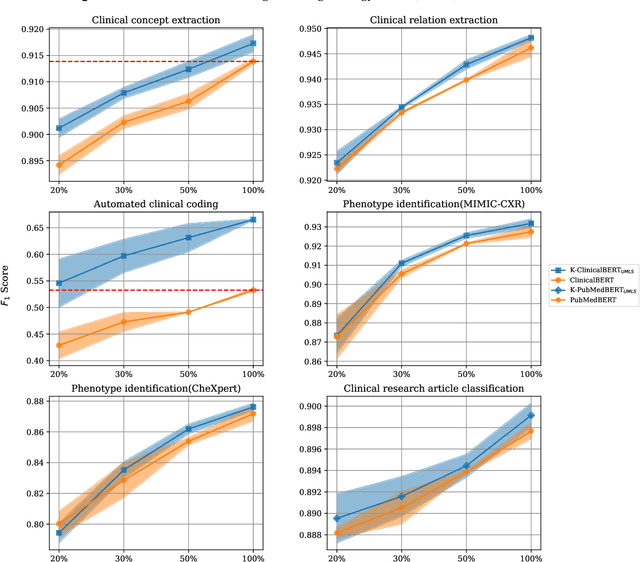
This study introduces a novel knowledge enhanced tokenisation mechanism, K-Tokeniser, for clinical text processing. Technically, at initialisation stage, K-Tokeniser populates global representations of tokens based on semantic types of domain concepts (such as drugs or diseases) from either a domain ontology like Unified Medical Language System or the training data of the task related corpus. At training or inference stage, sentence level localised context will be utilised for choosing the optimal global token representation to realise the semantic-based tokenisation. To avoid pretraining using the new tokeniser, an embedding initialisation approach is proposed to generate representations for new tokens. Using three transformer-based language models, a comprehensive set of experiments are conducted on four real-world datasets for evaluating K-Tokeniser in a wide range of clinical text analytics tasks including clinical concept and relation extraction, automated clinical coding, clinical phenotype identification, and clinical research article classification. Overall, our models demonstrate consistent improvements over their counterparts in all tasks. In particular, substantial improvements are observed in the automated clinical coding task with 13\% increase on Micro $F_1$ score. Furthermore, K-Tokeniser also shows significant capacities in facilitating quicker converge of language models. Specifically, using K-Tokeniser, the language models would only require 50\% of the training data to achieve the best performance of the baseline tokeniser using all training data in the concept extraction task and less than 20\% of the data for the automated coding task. It is worth mentioning that all these improvements require no pre-training process, making the approach generalisable.